
What Inks are Used for Glass Screen Printing? Analysis of Mainstream Product Selection and Industry Application Trends
With the continuous upgrading of glass deep-processing industries such as home appliance glass, automotive glass, beverage packaging, decorative slabs, and advertising light boxes, screen printing has become a core process for glass texture decoration, signage printing, and light-blocking enhancement. Many processing companies commonly wonder: what inks are used for glass screen printing? For different glass materials, processing techniques, and application scenarios, the industry mainstream uses specialized Glass Ink, which is subdivided into two core systems: water-based high-temperature and LED-UV curing. This is combined with standardized Screen Printing Ink processes, among which environmentally friendly Water Based Ink has become the mainstream choice for green mass production.
Unlike ordinary paper, plastic, and textile screen printing inks, glass surfaces are smooth and dense, requiring stringent adhesion and adaptability to special conditions such as high-temperature tempering, temperature fluctuations, water washing, and outdoor weathering. Therefore, ordinary screen printing inks cannot be used; specialized ink products with optimized formulations and specifically developed for glass substrates must be used. Currently, the domestic glass screen printing industry has formed two main categories: water-based high-temperature glass ink and LED-UV low-temperature curing glass ink. These have completely replaced traditional oil-based solvent-based inks and are suitable for all scenarios of glass screen printing production.
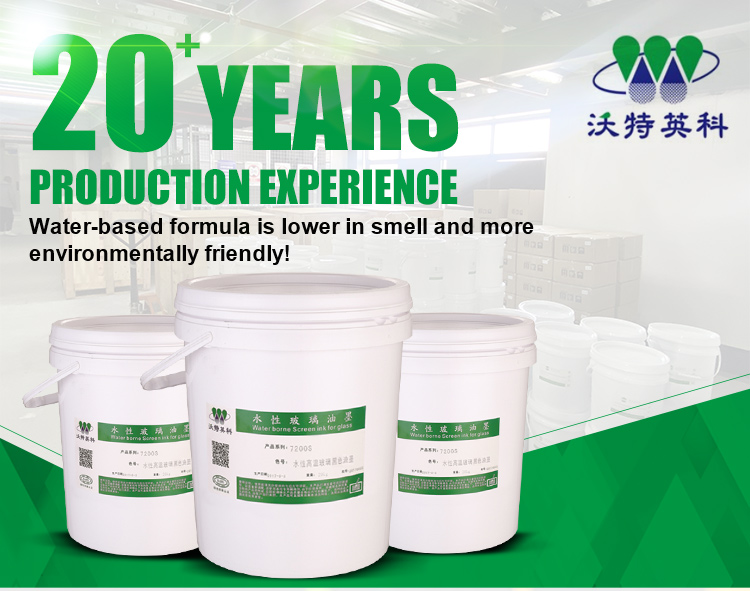
1. Core Mainstream: Water-Based High-Temperature Glass Ink As the main ink for mass production in glass deep processing, water-based glass ink is a core material used in the integrated tempering of raw glass and the high-temperature baking process of finished glass. It is also the preferred glass ink for compliance in the home appliance, automotive, and building materials glass industries. This type of ink uses deionized water as the dispersion medium, combined with high-temperature resistant silicone-acrylic resin, low-expansion glass frit, weather-resistant inorganic pigments, and special silane adhesion promoters. It eliminates the volatilization of organic solvents such as benzene and ketones at the source, resulting in low VOCs and low odor. The screen and squeegee can be cleaned with water, significantly reducing the cost of hazardous waste disposal in the workshop and making it suitable for standardized cleanroom production workshops.
In terms of manufacturing process, this screen printing ink is available in two types: a single-component tempered sintering type and a two-component baked type. The single-component type undergoes integrated tempering and sintering with the raw glass at 660–720℃, resulting in a strong adhesion through fusion and penetration with the glass surface, offering resistance to edge abrasion and high-pressure washing. The two-component type is suitable for secondary printing on already tempered glass, undergoing high-temperature baking at 180–240℃ to cross-link and form a film, meeting the needs of modified and customized production.
With its excellent weather resistance, this water-based glass ink can withstand thermal cycling from -30℃ to 70℃, high-temperature and high-humidity aging, and repeated scrubbing with alcohol and detergent. It does not peel, fade, or whiten over long-term use, and is widely used in refrigerator and air conditioner glass panels, automotive sunshades, stone-textured glass, home partition glass, and wine bottles, perfectly suited for high-volume automated screen printing production lines.
2. High-Efficiency New Product: LED-UV Curable Glass Ink
Targeting scenarios involving rapid printing on finished glass, small-batch customization, and printing on high-temperature sensitive substrates, the industry has widely adopted LED-UV curable glass ink, belonging to the category of high-efficiency, energy-saving glass inks. This ink requires no high-temperature baking, relying on a 395nm LED UV lamp for instant curing in 0.5–3 seconds. With a cold curing temperature ≤60℃, it does not cause damage to the glass coating or deformation of thin glass, solving the pain points of traditional high-temperature ink processes and the low efficiency of oil-based inks.
As a new type of screen printing ink, UV glass ink has a solid content exceeding 95%, with no solvent evaporation and no waste gas pollution. It is a single-component ink requiring no mixing and has no activation period limitations. Residual ink can be recycled and reused, resulting in production losses far lower than two-component water-based inks. Its film is dense and hard, with excellent wear and scratch resistance and anti-aging properties. It is suitable for printing fine graphics, logos, and light-shielding layers on advertising light box glass, 3C touch screen covers, cosmetic glass bottles, and high-end decorative glass, making it the preferred material for high-speed automated screen printing production lines.
3. Traditional Obsolete Category: Oil-Based Solvent-Based Glass Inks
Early glass screen printing primarily used oil-based solvent-based inks, relying on organic solvent dilution and high-temperature drying to form a film. These inks have a pungent odor, exceed VOC emission standards, require explosion-proof modifications to workshops and large-scale waste gas treatment equipment, and involve high hazardous waste disposal costs and significant environmental risks. They also suffer from defects such as easy film cracking, poor weather resistance, and easy fading and peeling with long-term use. With the upgrading of domestic environmental regulations and industry quality improvement, they have been gradually replaced by water-based inks and UV glass inks, and are still used only in a small number of low-end niche applications.
4. Industry Selection Core Standards: Precise Matching of Screen Printing Processes
Industry technicians indicate that there are no universal standards for selecting glass screen printing inks. The core principle is matching the processing technology with the application scenario: For mass production of tempered raw glass, water-based high-temperature glass inks are preferred; for rapid customization of finished glass, fine graphic printing, and low-temperature production requirements, LED-UV curing glass inks are the preferred choice; ordinary plastic and textile screen printing inks are avoided throughout the process to prevent quality problems such as poor adhesion, high-temperature failure, and insufficient weather resistance.
Simultaneously, using specialized auxiliary materials can significantly improve printing quality. Water-based inks are compatible with water-based thinners, and UV inks are used with UV reactive thinners, effectively solving common screen printing problems such as screen clogging, sagging, and pinholes, ensuring the stability of the screen printing ink and the yield rate of finished products.
5. Industry Development Trends: Environmentally Friendly and Efficient Inks Become the Absolute Mainstream
Driven by both the dual-carbon policy and environmental access standards for end-user brands, the glass screen printing industry has completed the iterative upgrade of its inks. Traditional oil-based inks, characterized by high pollution and energy consumption, are rapidly being phased out of the market. Water-based glass inks, combining environmental friendliness, stable performance, and compatibility with all processes, along with energy-efficient UV glass inks, are becoming the standard configuration for glass screen printing inks in glass deep-processing enterprises. In the future, environmentally friendly screen printing inks with low migration, high weather resistance, and multi-functional properties will continue to lead the glass printing industry towards greener, more refined, and more efficient development.
Contact Us: What's App 86-18022025378
Email: yan@lauerink.com